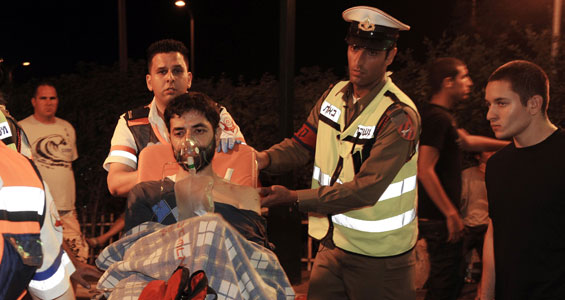
Israel has dropped plans to prosecute some of the detained passengers of the Freedom
Flotilla under mounting international condemnation [AFP]
Israel has started releasing the 700 activists it captured after it troops stormed a flotilla of ships carrying humanitarian aid to Palestinians in Gaza.
Turkey sent three planes, including two military ambulance aircraft, to bring its nationals home.
Six Greek passengers returned to Athens on Tuesday after being expelled from Israel.
On Wednesday morning, another 124 passengers reached Jordan after being freed.
Here are excerpts of what some of the freed passengers had to say:
Mohamed Vall, Al Jazeera reporter
The Israeli assault took those of us on the ship by complete surprise.
During that hour an half in the early morning everybody on board the ship thought that no-one would survive the Israeli attack because we saw about 30 war vessels surrounding this ship and helicopters attacking with very luminous bombs, the sound of them makes you think you are dead
That was a fear of war, complete war, on a ship that was full of men, women and even children.
The first soldiers on the ship were not killed, they were not shot at, they were captured by the defenders of the ship.
Moments later another bigger helicopter landed more troops and this time they fired immediately at people and killed as many as they could so that they could reach the cabin and take control of the ship.
I saw blood spilt on the ship and everyone knew that there was no weapons. we all knew the Israelis would intercept us and try to stop us, but we didn’t think that they would open fire at the first moment.
I have been shown the picture of a Yemeni man, and this is ridiculous, who was on the ship and most people know that every Yemeni in the world has a Yemeni style knife, that is a cultural thing and does not have anything to do with violence.
I understand now that in Israel they are trying to make a big deal about that, saying that the boat was full of violent people and just because of that one man.
Othman Battiri, Al Jazeera crew member
At 4:15, tens of Navy boats carrying tens of soldiers tried to board the ships. They were met by resistance. Peaceful resistance. Helicopters came and tried to download soldiers. They could not.
At that moment, they started firing live ammunition.
First, they fired sound and gas bombs and rubber bullets. Some people were injured from the rubber bullets. Then, live bullets were used. I saw several men being wounded. We tried to help some of the wounded. I saw four people who were killed.
I saw two people die before my eyes. One of them had a bullet in the chest. The other was bleeding but I did not know where he was shot.
We went down to see the other dead people. One had a bullet in his head as if he was hit by a sniper. Live bullets were every where.
They did not respect that all those on the ships were civilians. There were no weapons.
There was not firing by the activists on the soldiers. As media we stand witnesses on that.
They four dead people that I saw were all Turkish. Two were old men. The other two were younger. One of the young people was a coordinator in the media room. His name is Juwdat.
We heard that more people were killed. I only saw four. Most of the fighting took place on the upper level around the room of ship captain, where the activist tried to prevent the soldiers from trying to control the captain’s room. This is where live ammunition were used.
The attack started at 4:15 and ended around 5:30 when we heard that the ship was controlled by the Israeli’s.
Around 7:00 they asked us to leave our rooms and they started tying our hands.
Hazem Farouq, Egyptian MP from the Muslim Brotherhood
Helicopters were flying above us. Four military ships and 10 Navy boats surrounded us. They rained us with sound and gas bombs as if we were in real war.
Four people died before my eyes and in my hands. We could not find any first aid material. What happened required a field hospital to treat the injured. I did not have the necessary material to treat their bleeding wounds.
When we tried to carry the injured, the Israeli soldiers refused to allow men to carry the wounded. They pointed their guns with laser light toward their heads. They asked women to carry the wounded. Some women could not.
The wounded were very hurt because they were not carried in the proper way through the stairs and narrow doors.
Farouq is a dentist who was on board Mavi Marmara, the lead ship of the flotilla. He spoke to Al Jazeera after arriving in Cairo.
Issam Zaatar, Al Jazeera cameraman
I was filming, and then he [an Israeli solider] ran after me with a stun gun.
He could not catch me. One of his colleagues hit my hand from behind with a stun gun. My camera fell down. He ran to crush the camera with his feet.
I told him, don’t break my camera. If you want the tapes, I will give them to you. I told him these are media equipment. They had no limits.
They used rubber bullets. They used tear gas bombs. It was an unbelievable scene.
Haneen Zubi, Palestinian member of the Knesset
We were expecting the Israeli army to stop us, to prevent us from entering but surely we didn’t expect such a war against us.
It was 14 ships which approached us, nearly at 4.30 in the morning. Fourteen ships that I could count and one helicopter. Maybe more than 10 soldiers, I couldn’t say exactly [how many] were getting out of the helicopter.
On the second floor of the ship there were just passengers who are journalists, a nurse and organisers of the flotilla who didn’t have anything in their hands.
After 20 minutes, maybe 15 minutes, there were three dead bodies.
It ended at six, when a voice from the microphone said the ship was controlled by the Israelis, ‘please enter the rooms’.
Norman Paech, former member of the German parliament
This was not an act of self-defence [by the Israeli army], but rather it was completely disproportionate – although we were counting on our ship being blocked and maybe checked.
This was a very serious offence, this was a war crime.
I personally saw two and a half wooden sticks which were used [by activists].
We had not prepared in any way to fight. We didn’t even consider it.
No violence, no resistance – because we knew very well that we would have absolutely no chance against soldiers like this.
Mihalis Grigoropoulos, Greece
I was steering the ship, we saw them [Israeli soldiers] capture another ship in front of us, which was the Turkish passenger vessel with more than 500 people on board and heard shots fired.
We did not resist at all, we couldn’t even if we had wanted to. What could we have done against the commandos who climbed aboard?
The only thing some people tried was to delay them from getting to the bridge, forming a human shield. They were fired upon with plastic bullets and were stunned with electric devices.
There was great mistreatment after our arrest. We were essentially hostages, like animals on the ground.
They wouldn’t let us use the bathroom, wouldn’t give us food or water and they took video of us despite international conventions banning this.
Nilufer Cetin, Turkey
We stayed in our cabin and played games amid the sound of gunfire.
My son has been nervous since yesterday afternoon … I did not need to protect my son.
They knew there was a baby on board. I put a gas mask and life jacket on my son.
We did not experience any other problems on board, only a water shortage.
We took walks on the deck, played games with my son. The curtains were drawn, so I did not see the raid as it was happening. I only heard the voices.
There are lightly and heavily wounded people.
There are thousands, millions of babies in Gaza. My son and I wanted to play with those babies. We planned to deliver them aid. We wanted to say: ‘Look, it’s a safe place, I came here with my baby-son.’
I saw my husband from a distance, he looked okay. The ship personnel was not wounded, because they [the soldiers] needed them to take the ship to port.
I will go again if another ship goes.
Cetin returned to Istanbul airport with her one-year-old son.
Youssef Benderbal, France
The instructions were clear. Do not provoke, remain calm and go to meet them [the commandos] saying ‘we are pacifists and not terrorists’.
Masked commandos took possession of the ship. They were aiming for the captain’s cabin.
Benderbal was not on board Mavi Marmara, the lead ship of the flotilla, but on one of the other five ships. He gave this account to Europe 1 radio after arriving at a Paris airport.
Dimitris Gielalis, Greece
Suddenly from everywhere we saw inflatables coming at us, and within seconds fully equipped commandos came up on the boat.
They came up and used plastic bullets, we had beatings, we had electric shocks, any method we can think of, they used.
Gielalis was on board the ship Sfendoni.
Mutlu Tiryaki, Turkey
When we went up to the deck, they emerged from helicopters and military boats and attacked us.
They approached our vessel with military ships after issuing a warning. We told them we were unarmed. Our sole weapon was water.
Source: Al-Jazeera
Original article published on June 2, 2010
About the author
Tlaxcala is the international network of translators for linguistic diversity. This article may be reprinted as long as the content remains unaltered, and the source and author are cited.
URL of this article on Tlaxcala: http://www.tlaxcala.es/pp.asp?reference=10712&lg=en



 PRINT THIS PAGE

