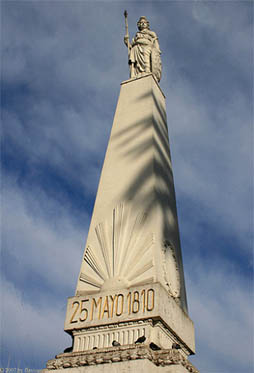
 Nothing to celebrate. Nothing to cheer. Neither the homeland that excludes us nor the nation artificially built upon the bones of victims of extermination processes. The Bicentennial that the ruling party and some from the opposition celebrate today in Argentina is no more than the revival of a project of exclusion; the project of a small and reduced number of “patriots” for whom the homeland, or actually the people who lived and live on this land, matters little.
They mattered little in May 1810, when behind closed doors in the Cabildo (town hall), these “patriots” only rushed to negotiate the allotment of abandoned land; and they matter little now, in this May 2010, when on behalf of that alleged Revolution, the territory is still being raffled to the highest bidder. The exclusion of important social sectors thus continues and is perpetuated in an orgy of waste.
Meanwhile, those who were starving then, are still starving today, May 25, 2010, in a territory that can feed 10 times its population. Those who celebrate the Bicentennial are the heirs of those who imposed a country model based on genocide, persecution, hunger, unemployment, and inequalities, among other calamities.
Now as then, the external debt is still being paid, whilst still postponing forever and ever the internal debt for which the native people are still dying, the poor are still dying, the disadvantaged of the system are still dying, the indigent people are still dying, the “nobodies”, those nobodies that neither now nor in 1810 had access to the Cabildo, so celebrated, illustrated, and honoured today.
Exactly a year ago, I said that the bicentennial was not my project, but that of a bourgeoisie that shaped the country in its own image and likeness. As opposed to 1810, what we can positively assert is that today, large social sectors throng before the established powers and demand that the “Open Cabildo” include all inhabitants of this land, today called Argentina. For many years now, albeit more disperse than in the 70s, the people expressed in several ways their claim that another social model be built, that other social relations be set, of means of production other than the capitalist one, a model that began being shaped precisely that May 25, 1810, when some “patriots”, far from “serving the homeland”, were seeking the best way to join that capitalist world that was starting to spin.
Cartoon by Jomra for deigualaigual
Let’s remember that that burgeoning capitalist world, which we suffer today in cycles of unending crises throughout the planet, had its origins in processes that stretch from the Industrial Revolution in England and the French Revolution in Gaul land to the US Independence with its Constitution anon, and some quite questionable declarations of rights, especially those of property, which enclosed lands and encouraged local elites to set up borders, mined today, with walls that are impassable for common folk. Thus, as I was saying, the patriots of the open Cabildo of May 1810 never sought to build an inclusive State. Perhaps the one who came closest to such an ideal was Mariano Moreno, murdered a few months after the First government Junta was established and in which he partook, precisely because of his proposals that seemed really revolutionary for those times. Today the May ideal is closer to the authoritarianism of Cornelio Saavedra, first “homeland” president, than to the Moreno model described in the Revolutionary Operative Plan.
Mariano Moreno Cornelio Saavedra
The squandering at the Bicentennial in the mirror of the peoples’ march
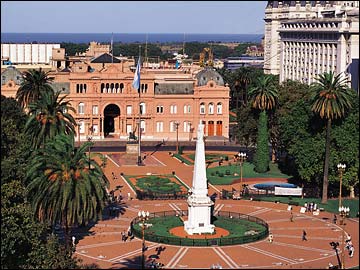 The excessive festivities of a country that has nothing to celebrate contrast with the march held by native people from all over the territory to demand inclusion in the national project. It has to be repeated over and over: the Bicentennial is not a celebration that includes all inhabitants of the Argentinean State. The nationalism expressed in thousands of blue and white flags and in stands neatly placed along the 9 de Julio Avenue in Buenos Aires contrasts with multicolour flags that represent the aborigines and that were present on Friday, May 21 at the Plaza del Cabildo. It was again demanded that the Open Cabildo be for all. Presidential declamations are not enough for a country to end overnight with 200 years of opprobrium, silence, genocides and dictatorships, exclusion, malnutrition, unemployment…nor is it enough to congregate the middle class in the Plaza de Mayo to evoke a Cabildo that, we repeat, is exclusionary by nature.
Plaza de Mayo – a lo largo del tiempo (in time), by Andrés Alvez, 2007
Somebody once said that the Plaza (de Mayo) is of the people. And the people have been crying out, for about 200 years, to be included in discussions over what project of country to build. While the Kirchner administration, the last link in a long chain of bourgeois States, continues paying the external debt, 200 years later, the only debt this State must pay, that is, the internal debt, not only has not been paid but continues being postponed to an indefinite future.
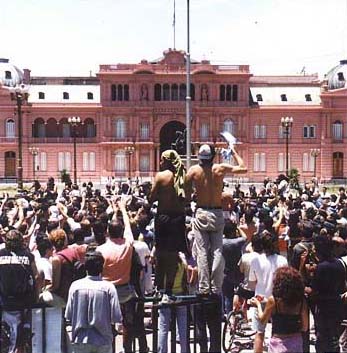
Plaza de Mayo, 2001 and 2009
Darío Aranda, in the newspaper Página 12, set in black and white the claims of native people: “… the same univocal and forceful claims of the last two centuries: land, rejection of the companies that evict them, respect for their ancestral culture, and justice for past and present abuses.” And a song that in unison rang throughout the territory: “La tierra, robada, será recuperada” (The land that was taken will be retaken), with its echoes resounding in every corner where an indigenous community dwells; a cry that sounds stronger coming from the Argentinean northeast whenever the last person murdered by the zeal to control and conquer is remembered. The fact is that the cold-blooded murder of Cacique Javier Chocobar, exactly on October 12 (2009), will still be the banner that today, 200 years after 1810, flaps in the face of the political leadership that continues looking at the others, the indigenous peoples and the aborigines, with a disdain akin to that felt by many of the “homeland heroes” of the Open Cabildo.
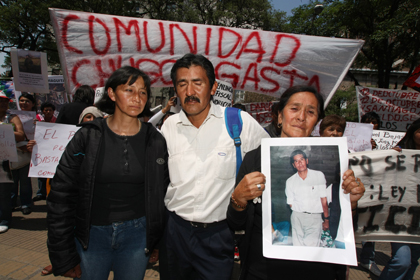
Demonstration in Plaza Independencia of Tucumán on October 20, 2010, organised by the National Association of the Diaguita People (Unión de la Nación del Pueblo Diaguita) to demand justice for the murder of Javier Chocobar by landowner Darío Amín and ex police officers under his service, in El Chorro, Trancas.
The sorrows were always ours, the resources belonged (and belong) to others
Singer and composer Atahualpa Yupanqui composed “El Arriero” (“The Herder”) many years ago and as though connecting past, present, and future, he expressed better than anybody what it meant to build this State that emerged from the Open Cabildo of May 22, 1810. Simple, unassuming, and forceful Yupanqui said it justly: “Sorrows and precious cows ride on the same trail; sorrows and precious cows ride on the same trail, “the sorrows are ours; the precious cows belong to others.”
And the land, and the oil, and the natural resources, and the food, and… the sorrows, for 200 years and more, they are still ours, of the common folk, of the poor, of the aborigine people, of the unemployed, of the children who die from malnutrition, of the elderly who not only have a lean pension that falls short by the end of the month but who also see how the State is inefficient in health and service matters, where education has been dismantled, where everything is sold and raffled to the highest bidder, including the dreams of the “nobodies.” Two hundred years and we are still suffering for the precious cows that leave the country to go abroad. And this, it must be repeated out loud once again, is no reason to celebrate. A nation or a State cannot be built on the foundations of such injustices.
But let’s be clear, it is such State that began being shaped on May 25, 1810 and that is celebrated today by the Argentinean bourgeoisie in the streets with a nationalist spasm inconsistent with reality.
The Open Cabildo of May 22, 1810
MoviStar sponsors the Argentinean “Independence”
But let’s go even further and give a clear example of all that is being said here. I recently had the opportunity to watch a “documentary”, if a production of the Argentinean private TV channel can be so called, where a self-proclaimed historian, i.e., Felipe Pigna, attempted to explain, simplistically and with a discourse at times too easy and elementary and at times childish, the process of the Independence of Argentina.
Even the title of the saga is opprobrious considering our country’s recent history: Algo habrán hecho (They must have done something), a phrase that brings back the vile justification of the last dictatorship for disappearing 30.000 social militants. As I was saying, the phony documentary is a linear narration with scarce internal conflict, with no debate whatsoever over the construction of the State, a revolutionary heroic deed worthy of Spielberg’s best script. The fact in itself is that this work, light and easily digestible for the Argentinean middle class, is sponsored by MOVISTAR, Spanish company that shares the responsibility for dismantling the Argentinean State from the 90s to this date. How can the Argentinean history be sponsored by a company that responds to the interests of foreign private entrepreneurs?
Let’s agree then that Felipe Pigna, as Felix Luna was in life, is the “historian” chosen by the establishment to narrate the official story and quiet the masses with a soothing harmonious story. At this point, renaming our distinguished historian “predatory” does not seem unwarranted or out of context. For those of us who are devoted to the study of history with a scientific viewpoint, it is impossible to ascribe to a lightly written thesis in order to satisfy a given audience; much less do we let our research be funded or sponsored by private capital enterprises involved in the process of our inquiries. This borders the absurd and poses very serious criteria of a moral and ethical nature. Let’s think for an instant in questioning opencast mining and its ensuing environmental contamination in a research piece funded by Barrick Gold, or let’s think in doing research on oil-based contamination with the funds of PB or Repsol YPF. What kind of account will the history funded by companies like MoviStar, Repsol, YPF, or Coca Cola tell us? For the “predatory” historian, being sponsored by a predatory company seems normal, as normal as a narration of the Argentinean history itself where those who contributed to shape this excluding state 200 years ago are set in bronze anew. The end of the story that would very much delight Francis Fukuyama and many ideologists of the so-called Neoliberalism. How to question the history of Argentinean capitalism when one of the companies that benefitted the most from the capitalist exploitation of this territory provides its monies to help build the narrative discourse? The equation is simple and the result we already know: “Algo habrán hecho.”
The story of the other Argentinean May
A year ago and in the same article in which I questioned the Bicentennial, I highlighted the other Argentinean May, May of ‘69, which found in the street skirmishes of the AZOS cycle, the pinnacle of struggle and rebellion of an entire Seventies’ generation that had misgivings over building a country upon the capitalist social relations of production and reproduction. Since the Cordobazo[1], passing through the Rosariazo, the diverse Tucumanazos or the Mendozazo, among other protest movements, the 70s generation wished to confront the country that today celebrates the Bicentennial with fanfare. Narrations from the Seventies tell us about an inclusive country, where everybody is to be invited to the Open Cabildo to discuss and debate seriously which social construction model was to be established on Argentinean soil. Even better, they moved the debate from the Cabildo to the streets, they took the discussion to student centres, university cafeterias, and to workers’ factories, where university laws or labour laws were discussed in true political “cultural gatherings,” like the ones experienced in mythical cafes in the large Argentinean cities. All socialist and anarchist trends served the homeland truly in real open assemblies the discussed what country and what social model they wanted.
But they were also active; they were militants in an ample sense of the term, passing from discourse into action, facing the dictatorship of the day, and responding to the spirit of the times that, since the French May, the Cuban revolution, and the triumph of Allende in Chile, was contagious and a spreading example. A generation that risked their lives for an ideal of justice and equal distribution of wealth, a very different generation from that of the “founding fathers of the patria”. That generation was liquidated by the self-proclaimed National Reorganisation Process, established after the March 24, 1976 coup d’état, which instituted a systemic plan based on terror and on vanishing people. Let’s be clear once more and use no euphemism: the Argentinean military called their project National Reorganisation Process to go back to the roots of Argentinean history, and those roots, hurtful or anguishing for most, also collapse at the doors of the Open Cabildo of May 1810; the “Process” that today the Argentinean bourgeoisie celebrates with the Bicentennial.
May, the Bicentennial and afterwards, or the construction of another State
As if this were not enough, the road of the bourgeois celebration of the Bicentennial is only starting this May 25, 1810 and promises to continue for six long years until the “Great Celebration” of the Bicentennial of the Independence. In Tucumán, the central acts of this celebration have already been announced with fanfare since it was in the “garden of the Republic” where the so greatly proclaimed Argentinean Independence was sealed a 9th of July of 1816. Again we must warn that this celebration will not be ours either. If the existing social, economical, political, and cultural model does not change in the next years, the landscape will be identical to the one we live today, and we must then question not only the own historic narration of the “predators,” but also question yet again the overall model being celebrated. We must avow firmly and out loud that today the smallest and most densely populated province of the country is still downcast within a belt of marginality, with a health system collapsed and in crisis, with an education that not only does not reach everyone but also puts into question the basic education of new generations, with a welfare system that lets its elderly die, with an assistance system that practices electoral band-aid measures in times of campaigns, distributing breadcrumbs without considering a real redistribution of wealth. Moreover, INRI, the recent past will continue unrevised, with no condemnation of the repressors of the last military dictatorship, who by July 9, 2016, will go on dying without hearing a sentence that acknowledges them as the genocides they are.
The opprobrious listing of the inequalities that this celebrated model generates is endless but to prove my point, two examples should suffice. May opened the road in 1810 to build a model of an exclusionary country. May 69 would open the road to discuss another construction for an inclusive country. Between adopting the ideals of one May or the other, we will have to debate once more what country we have and what country we want, otherwise, we will relive another century as the one that is ending, and future societies, far from living in a just and egalitarian social State for all of its citizens, will cry out again, while the heirs of the current bourgeoisie sit down once more at the banquet, this time of the Tercentennial. Of the struggles we, the popular sectors, are capable of winning depend any other way of writing our future independence: including and inviting all popular sectors to enter a TRULY Open Cabildo. Otherwise, the party will still be for a few. I, personally, do not celebrate it; and I guess that most of the inhabitants of the Argentinean land today do not celebrate it either.
Ramón Chiocconi, Marcelo Deza, Charly Galosi, Alvar Puente, Leonardo Proverbio, Damián, and Willy Benegas of the Bariloche Andean Club celebrated the Bicentennial on the Everest summit.
[1] The augmentative azo added to Córdoba, Rosario, Tucumán, and Mendoza (Argentinean provinces) refers to landmark events that happened there. They could be roughly translated as the Cordoba blow, the Rosario blow, etc. [TN]
Source: the author– Argentina: 1810-25 de mayo-2010: A 200 años ni Revolución, ni Bicentenario ni Celebraciones, la urgencia es construir otro modelo social distinto
Original article published on May 25, 2010.
About the author
Rubén Kotler is a guest author at Tlaxcala, the network of translators for linguistic diversity. This translation may be reprinted as long as the content remains unaltered, and the source, author, translator and reviser are cited.
URL of this article on Tlaxcala: http://www.tlaxcala.es/pp.asp?reference=10745&lg=en
 
|


 PRINT THIS PAGE

